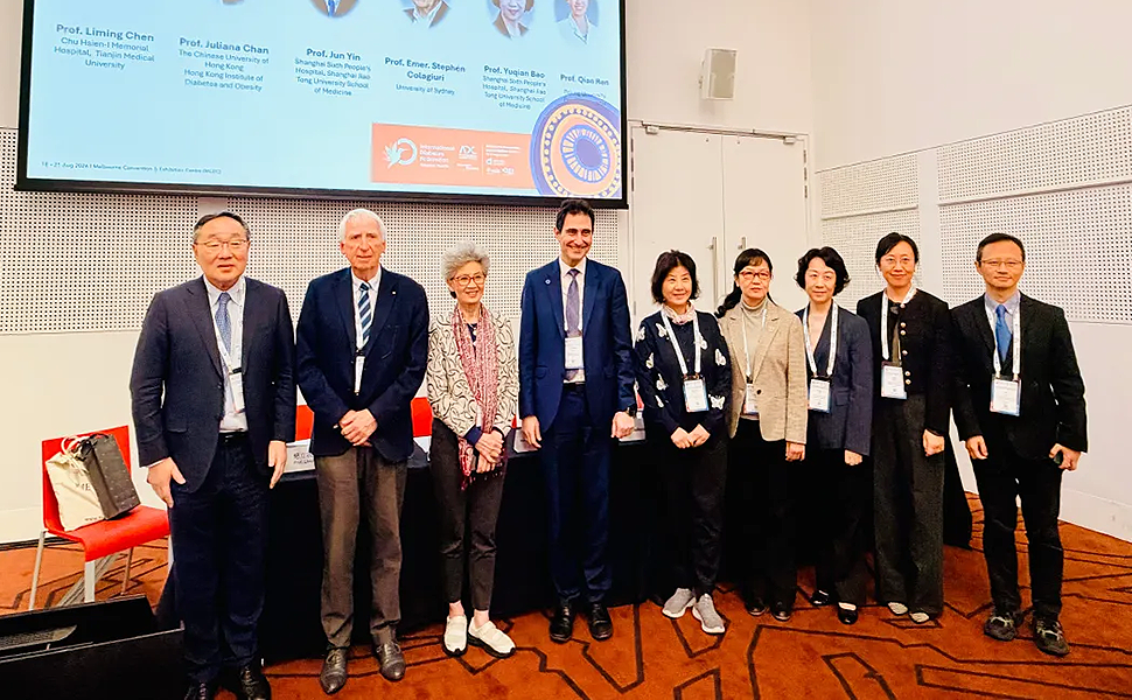
On 21 August, the International Diabetes Federation (IDF) brought together leading international and Chinese diabetes experts for a dedicated symposium at the IDF Western Pacific Region Congress 2026 in Melbourne, Australia. Through a simultaneous livestream, the scientific exchange also reached thousands of healthcare professionals in China.
The symposium, “Beyond GLP-1 RAs: Aligning Emerging Injectable Intensification Guidance with IDF Recommendations 2025,” was chaired by Professor Linong Ji, Director of the Peking University Diabetes Centre, and Professor Jonathan Shaw, Chair of the Programme Committee for the IDF Congress 2027 in Singapore. Professor Weiping Jia, Chair-Elect of the IDF Western Pacific Region, joined the session as a special guest.
China has the largest number of adults living with diabetes globally, with an estimated 148 million adults aged 20–79 living with the condition in 2024. This number is projected to rise to 168 million by 2050, underscoring China’s importance to the global diabetes response.
Opening the symposium, Professor Shaw highlighted China’s significance to the global diabetes response. He emphasised the value of sharing China’s clinical challenges, innovations and experience through IDF international platforms. Professor Ji highlighted the importance of translating emerging treatment strategies into real-world clinical practice.
Aligning emerging evidence with IDF recommendations
Professor Liming Chen presented an emerging guideline on treatment intensification with injectable therapies for people living with type 2 diabetes who do not achieve glycaemic targets with GLP-1 receptor agonist therapy. She highlighted the importance of individualising treatment intensification according to glycaemic goals, treatment tolerance, weight management needs and individual preferences.
Professor Stephen Colagiuri then presented the IDF Global Clinical Practice Recommendations for Managing Type 2 Diabetes – 2025, focusing on treatment pathways from non-insulin therapies to insulin.
He highlighted the Recommendations’ two-tier approach of Optimal Care and Basic Care, designed to support evidence-based diabetes management across health systems with different levels of resources and access to care.
Professor Stephen Colagiuri stated that both guidelines are consistent. The difference relates to IDF Basic Care recommendations where the starting point usually does not include Incretin Therapy. The new guidelines on treatment intensification beyond GLP-1 RA will be helpful in updating the IDF Clinical Practice Recommendations.
The presentations were followed by an expert panel discussion exploring how emerging approaches can align with IDF recommendations and translate into real-world practice across different healthcare settings.
Extending scientific exchange to China
The symposium attracted a near-capacity audience onsite and achieved strong reach in China, with the WeChat livestream generating over 9,000 views.
The hybrid format, supported by close collaboration between IDF, the IDF-WPR Congress and the Chinese partner, extended the scientific exchange beyond the Congress venue to a wider community of healthcare professionals in China.
The Beijing Medical and Health Foundation supported the symposium broadcast.