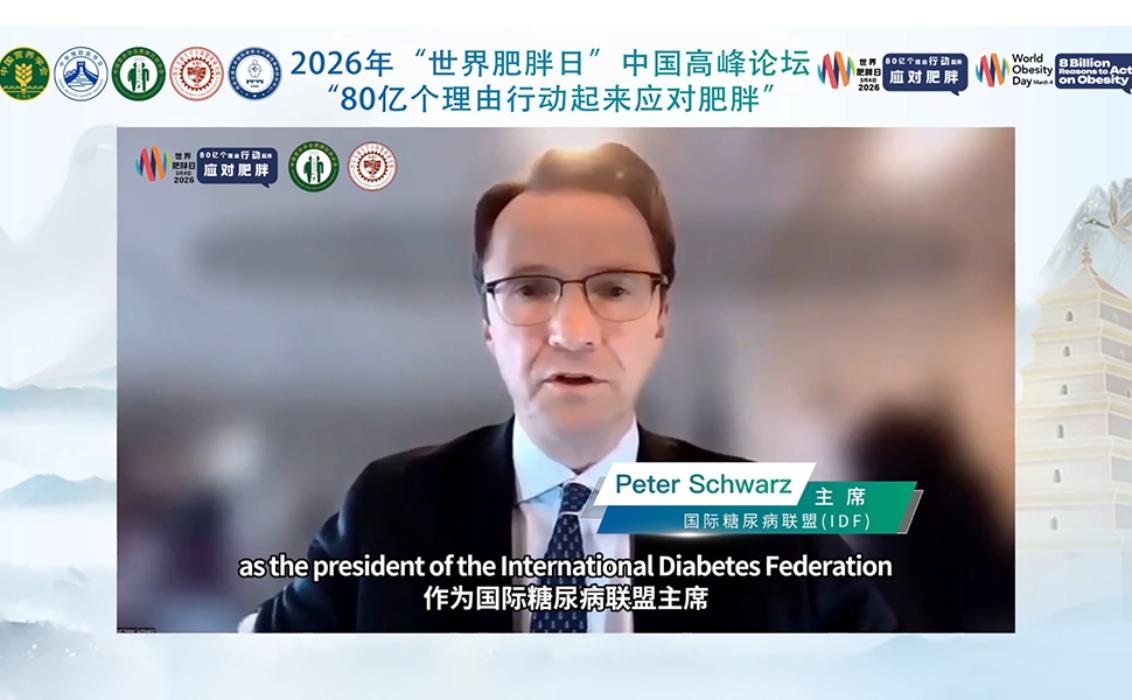
On 4 March, International Diabetes Federation (IDF) President Prof Peter Schwarz marked World Obesity Day (WOD) with a keynote address at the online World Obesity Day China Summit, reaching 1.1 million viewers across China.
The event was organised by the Obesity Prevention and Control Branch of the Chinese Nutrition Society, together with the Global Health Institute of Xi’an Jiaotong University and the International Research Centre for Obesity and Metabolic Diseases.
In his presentation, Prof Schwarz underscored the converging epidemics of obesity and diabetes. Emphasising the scale of the challenge, he highlighted that one billion people currently live with obesity with half of the world’s population projected to be living with overweight or obesity by 2035. Importantly, the impact extends beyond statistics, as a growing number of children and young people now face increased risks of type 2 diabetes and other non-communicable conditions early in life.
Rates of overweight and obesity among school-aged children have risen steeply, from 4% in 1975 to nearly 20% in 2022. This trend is especially pronounced in low- and middle-income countries, where access to prevention, diagnosis, and long-term care may be limited. Consequently, many children grow up without adequate support to protect their health.
With childhood obesity often continuing into adulthood, the risk grows for non-communicable diseases such as type 2 diabetes, cardiovascular disease and certain cancers. This underscores the urgent need for early and consistent prevention strategies.
Turning to diabetes data, Prof Schwarz referenced the IDF Diabetes Atlas, which estimates that 589 million adults worldwide are living with diabetes. One in four are in China, with nearly half undiagnosed.
He emphasised the strong pathophysiological links between obesity and type 2 diabetes, outlining IDF’s global actions to tackle both conditions. Prof Schwarz introduced the IDF Global Clinical Practice Recommendations for Managing Type 2 Diabetes, which define two levels of care and place weight management at the centre of treatment. He also stressed the importance of integrating physical activity, balanced nutrition, and structured diabetes education into prevention and care strategies.
In closing, Prof Schwarz called for strengthened cross-sector and cross-level global collaboration, improved care systems and reinforced policy support to build a comprehensive response to obesity and diabetes.
World Obesity Day, observed annually on 4 March, aims to raise awareness, drive policy action, and promote the exchange of best practices. This year’s theme, “8 Billion Reasons to Act on Obesity,” reflects the scope of the challenge and the crucial need for collective action.
On 1 March, the organisers hosted an online training on obesity prevention and management, during which Prof Schwarz delivered a brief address. The session attracted an additional 1 million participants.