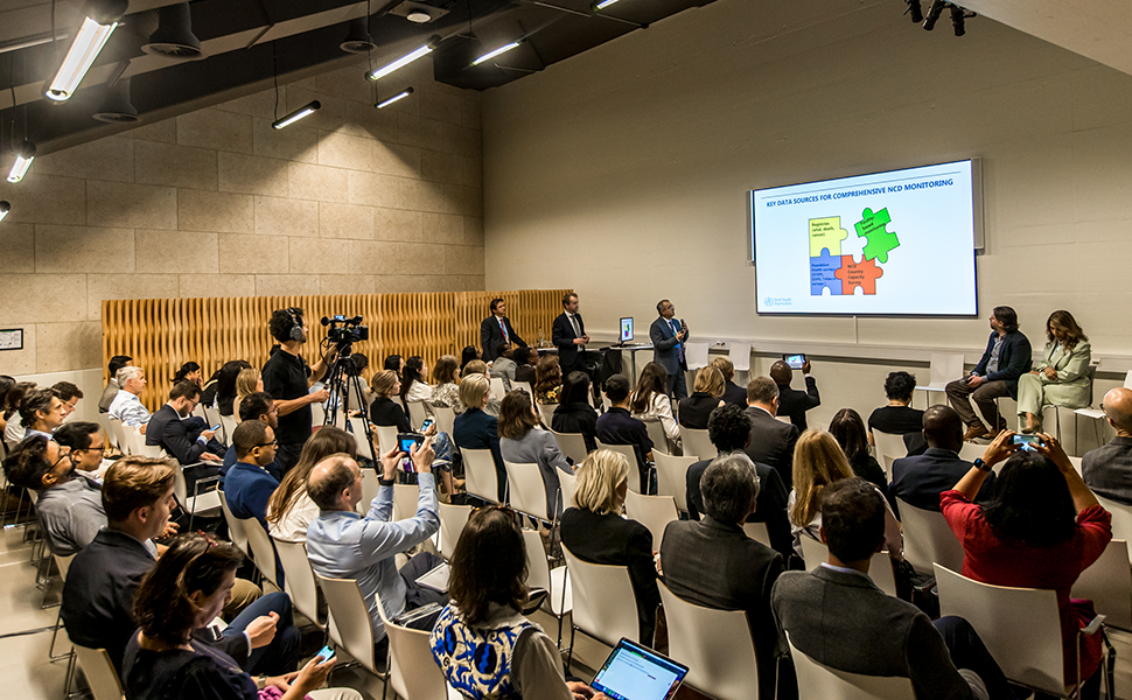
On the sidelines of the 78th World Health Assembly, global health leaders, digital health innovators, and country representatives gathered in Geneva yesterday to deliver the message: digital health transformation must take centre stage in responding to non-communicable diseases (NCDs).
During the joint event by the International Diabetes Federation (IDF) and the World Diabetes Foundation (WDF), held in the run-up to the 4th UN High-Level Meeting on NCDs, panellists underlined the potential of unified digital strategies and scaled investments to reshape health systems that can meet the NCD burden, especially in low- and middle-income countries. With 73% of NCD-related deaths occurring in these regions, there is an urgent need for action.
Moderators Professor Peter Schwarz, IDF President, and Mr Bent Lautrup-Nielsen, WDF Head of Global Advocacy, began the session by highlighting clause 39 of the upcoming UN declaration as a key chance to incorporate digital and assisted technologies into the global response against NCDs. They also stressed the need to make digital transformation central to prevention and care efforts worldwide.
The conversation that followed moved between high-level frameworks and the realities of putting digital health tools into practice on the ground. Dr Farshad Farzadfar, World Health Organization (WHO), outlined WHO’s approach to digital monitoring within the context of NCDs. Dr Farzadfar presented the organisation’s facility-based monitoring strategy and efforts to establish global frameworks for tracking diabetes prevention and management. He also stressed the importance of reliable, standardised data as the foundation for national and international responses, arguing that progress on NCD targets remains difficult to measure or sustain without consistent monitoring.
“We are not just talking about technology; we are talking about health equity, access, and ultimately, about saving lives.” Prof Peter Schwarz
Dr Michael Frost, University of Oslo, underscored the need to build local capacity, making the case that digital health systems only succeed when they are shaped by and anchored in the communities they aim to serve. His insights were grounded in his work on DHIS2, an open-source platform that has become vital to many countries’ health information infrastructure.
Speakers from Ministries of Health introduced real-life examples from national programmes to the discussion. Dr Elizabeth Onyango, representative of the Ministry of Health, Kenya, offered a look at the country’s digital journey, spotlighting TIEFA Care—Kenya’s ambitious Digital Health Superhighway—as a driver of better data quality and improved service delivery. From Tanzania, Ministry of Health representative Dr. Omary Ubuguyu shared the remarkable expansion of the Diabetes Compass project, which scaled from just eight pilot sites to over 5,000 facilities in only twelve months, illustrating how targeted digital solutions can grow rapidly when the right conditions are in place.
However, the transition is not without its obstacles. As Dr. Jackie Maalouf, IDF Vice-President and President of DiaLeb, pointed out, digital literacy remains a significant barrier, with many health workers needing training to use digital tools effectively. Dr Onyango echoed this point, adding that real transformation depends not just on infrastructure, but also on widespread education and stakeholder engagement at every level of health systems.
Despite the challenges, the panellists shared a common vision for moving forward. They called for interoperable digital systems, long-term funding commitments, stronger national policy and greater inclusion of people with lived experience. Innovations such as AI-driven clinical support and using everyday platforms like WhatsApp to engage people living with NCDs were presented not as futuristic add-ons, but as essential tools for building a more equitable, person-centred digital health landscape.
With the UN High-Level Meeting on NCDs in September, the event in Geneva offered more than just discussion—it delivered a call to action. Digital health could be a transformative force in the global fight against NCDs if the momentum sparked in these rooms matches real commitment. The message was clear: without bold, coordinated, and sustained investment in digital transformation, the global response to NCDs will remain fragmented and insufficient.